Imploding Resistance
An imploding duct typically refers to a situation where a duct or pipe collapses or collapses inward due to external or internal pressure differences. The dangers of an imploding duct can vary depending on the circumstances and the materials involved, but generally, they include:
- Property damage
- Safety hazards
- Reduced system efficiency
- Health risks
- Financial costs
- Disruption of services
Nordfab's Quick-Fit (QF) and FB test results
Below you'll see the test results from Imploding resistance of Nordfab's Quick-Fit (QF) and FB duct, with 0.7 and 0.9 mm thickness.
Imploding resistance galvanised duct QF & FB, T = 0.7 mm
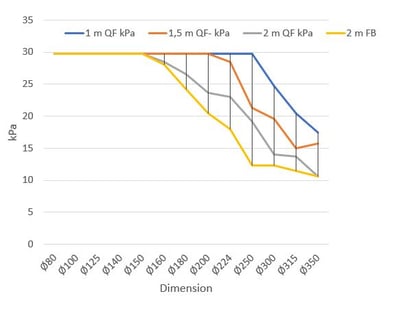
Imploding resistance galvanised duct QF & FB, T = 0.9 mm
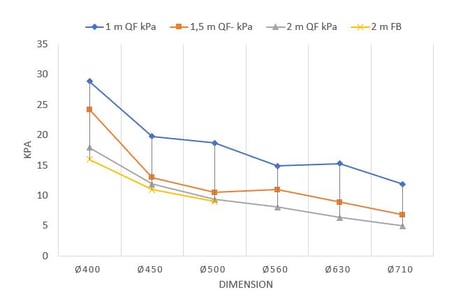
Imploding resistance galvanised and 304SS duct QF & FB, T = 1.25 mm
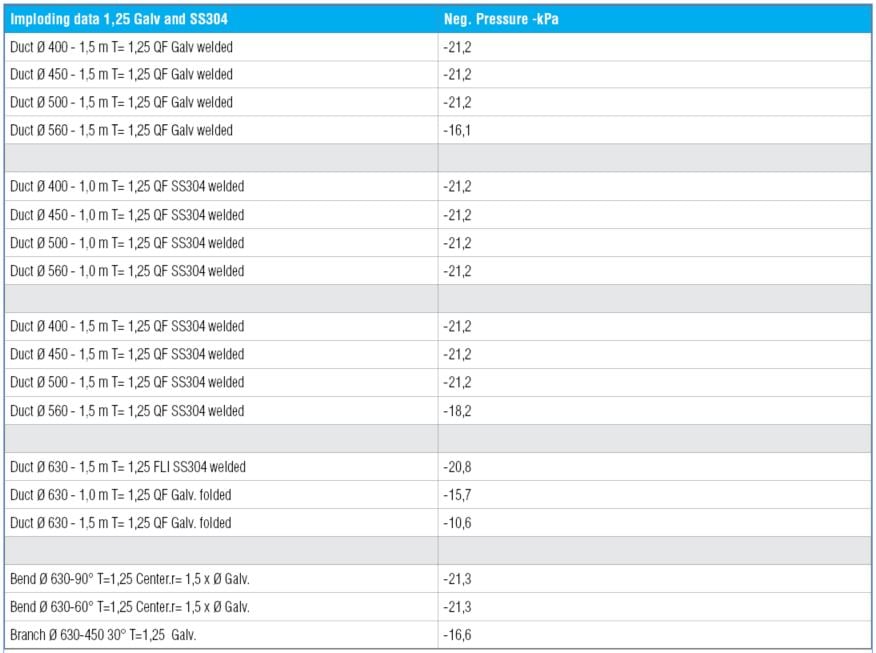
Please note that the imploding test for the 1,25mm duct was done using 3 ducts and a fan in our in-house test facility. The results should be seen as indicative and could be different when the ducts are used in a live production area.
How to avoid imploding duct
To eliminate the danger of an imploding duct, it's crucial to conduct regular inspections and maintenance of ductwork to identify and address any issues before they lead to a collapse. Additionally, proper design and installation of duct systems should consider factors like pressure differentials, material strength, and support to minimize the risk of imploding ducts. At Nordfab, we recommend the following to avoid imploding duct:
- No pulsation in ductwork
- No dents or scratches on duct
- Use of round ducts
- Use corresponding split straps, preferably attached at the middle of the duct
- Do not exceed the under pressure limits
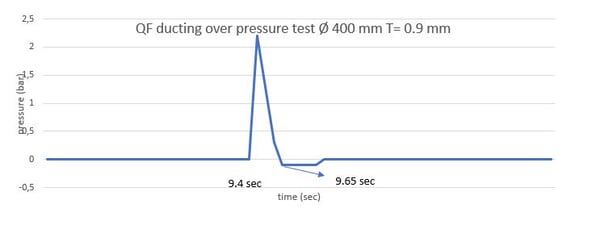
Quick-Fit (QF) ducting over pressure test Ø 400 mm T= 0.9 mm